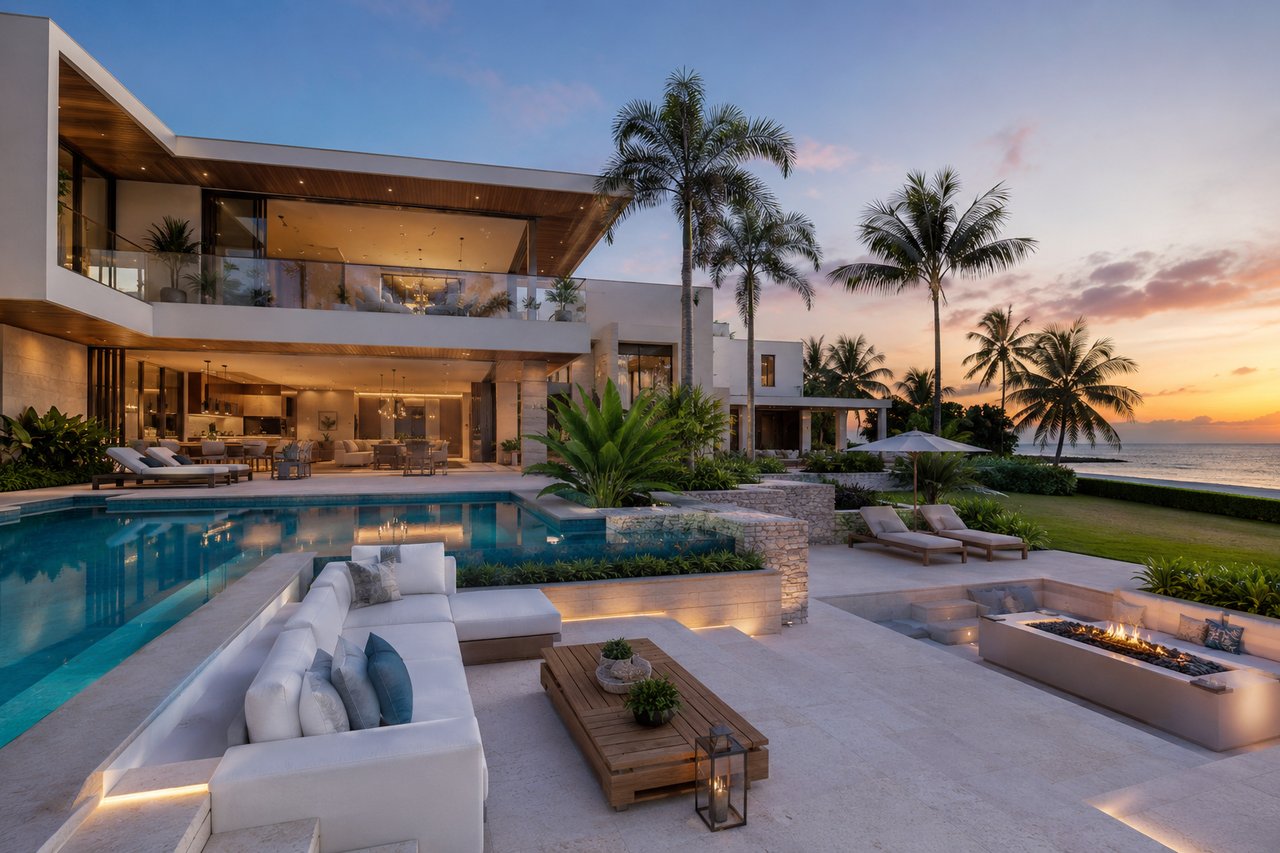
A guest house can transform the way a luxury property functions. For some buyers, it provides privacy for visiting family. For others, it creates a comfortable residence for household staff, an independent space for long-term guests, or additional flexibility as family circumstances change.
In Puerto Rico, properties with casitas, detached guest suites, or secondary residences can be particularly attractive because outdoor living, multigenerational use, and frequent entertaining are often important parts of the residential experience. But a separate structure should not be evaluated simply as an additional bedroom count.
The more useful question is: what does the guest house actually contribute to the property, and what does it require from the owner?
That means looking at access, privacy, utilities, construction quality, maintenance, legal documentation, security, and the relationship between the primary residence and the secondary structure.
For a buyer considering a luxury property in Puerto Rico, these details can materially affect both daily enjoyment and long-term ownership.
1. What Is the Guest House Actually Designed For?
Not every guest house serves the same purpose.
A detached structure might function as:
- A private guest residence
- A multigenerational living space
- A home for extended family
- A staff residence
- A home office
- A pool house
- A wellness or recreational space
- A flexible secondary residence
Before assigning value to the structure, buyers should determine its intended function.
A beautiful guest suite with a bedroom and bathroom may work perfectly for short visits but offer little independence for someone staying several weeks. Conversely, a full casita with a kitchen, living area, private entrance, and dedicated outdoor space may function almost like a second home.
That distinction matters.
Luxury buyers should evaluate the guest house based on function rather than square footage alone.
2. Privacy Should Be Evaluated From Both Sides
A guest house is most successful when it creates separation without making the property feel divided.
Consider the physical relationship between the main residence and guest structure.
Is the guest house visible from the primary bedroom?
Does the guest route pass through the main outdoor entertaining area?
Can guests arrive and leave without crossing private areas?
Does the structure have its own parking?
Can family members use the pool or outdoor areas without feeling that they are entering someone else's private residence?
These questions become particularly important for buyers who entertain frequently.
A guest house should ideally create independent comfort without compromising the privacy of the main residence.
The best configuration depends on the property, but separation can be created through landscaping, architecture, independent entrances, distance, orientation, and thoughtful circulation.
3. Look Beyond Bedrooms and Bathrooms
A sophisticated buyer should evaluate the guest house as a complete living environment.
Important questions include:
- Is there a proper living room?
- Is there a kitchen or kitchenette?
- Is there sufficient storage?
- Does the bathroom have appropriate ventilation?
- Is there a private outdoor area?
- Does the space have independent air conditioning?
- Are windows and doors appropriately protected?
- Is there adequate natural light?
- Is internet connectivity reliable?
- Does the guest house have convenient access to backup systems?
The difference between a bedroom with a bathroom and a genuinely independent guest residence can be substantial.
For a luxury property, functionality is part of the value proposition.
4. Understand How Utilities Are Handled
A detached structure can introduce additional infrastructure considerations.
Depending on the property, the guest house may share or separately use:
- Electricity
- Water
- Sewer or septic systems
- Internet
- Backup power
- Water storage
- HVAC systems
Buyers should understand how these systems are configured before closing.
For example, if the entire property relies on one generator, buyers should know whether the guest house is included in the backup-power load.
If water is supplied through a cistern or other storage system, the buyer should understand how capacity and distribution work.
This is not merely a technical issue. It affects how independently the guest house can function during normal operations and during periods when utilities are disrupted.
5. Examine Construction and Maintenance Separately
A guest house is another building envelope to maintain.
That means another roof, another HVAC system, additional plumbing, electrical components, doors, windows, exterior finishes, and potentially another kitchen.
During due diligence, buyers should therefore evaluate the guest house independently rather than assuming that the condition of the main residence represents the condition of the entire property.
Ask for maintenance records where available.
Look at:
- Roof age and condition
- HVAC servicing
- Water heaters
- Plumbing history
- Electrical systems
- Windows and doors
- Appliances
- Waterproofing
- Exterior paint or finishes
- Pest-control history
The objective is to understand whether the guest house is genuinely turnkey or whether it represents an additional capital-maintenance obligation.
6. Verify the Legal and Physical Configuration
A secondary structure deserves the same seriousness as the primary residence when it comes to documentation.
Buyers should work with the appropriate Puerto Rico professionals to determine whether the guest structure and its configuration are properly documented.
Questions may include:
- How is the structure reflected in the property documentation?
- Does the recorded property description correspond with the actual property?
- Are permits and approvals relevant to the structure?
- Are additions documented?
- Are there restrictions affecting use?
- Does the configuration create any title or insurance considerations?
A sophisticated buyer should not rely solely on the phrase "guest house" in a listing description.
The physical property, legal documentation, and transaction documents should be evaluated together.
7. Consider the Guest House as Part of the Property's Long-Term Strategy
One reason guest houses can be valuable is their flexibility.
A buyer may initially use the space for visiting family but later repurpose it as:
- A private office
- A residence for an adult child
- A wellness studio
- A creative workspace
- A home for household staff
- A private accommodation for long-term guests
This flexibility can make a property more adaptable as the owner's lifestyle changes.
But buyers should still evaluate whether the configuration is desirable for the local market and the property's eventual resale audience.
A highly personalized secondary structure may be less universally useful than a well-designed, flexible guest residence.
The WoodsLux Perspective
At WoodsLux Realty, we believe a guest house should be evaluated as functional real estate within the larger estate, not simply as an extra line on a property specification sheet.
The strongest properties create a natural relationship between the main residence and secondary spaces: enough separation for privacy, enough connectivity for convenience, and enough flexibility to accommodate changing lifestyles.
For buyers exploring Puerto Rico luxury properties with guest accommodations, the right questions extend beyond "How many bedrooms?"
The better questions are: Who will use this space? How independently can it function? What does it cost to maintain? And how does it contribute to the property's long-term usefulness?
Explore current WoodsLux luxury properties priced at $1 million and above:
Conclusion
A guest house can add significant flexibility to a Puerto Rico luxury property, but its value depends on much more than size.
Buyers should evaluate privacy, access, utilities, construction, maintenance, documentation, and long-term functionality before assigning a premium to a property with a casita or separate guest residence.
When properly designed and maintained, a guest house can make a luxury estate more adaptable to family, guests, work, and changing lifestyle needs.
FAQ
Is a guest house valuable in Puerto Rico luxury real estate?
It can be, depending on its design, condition, privacy, functionality, and relevance to the property and buyer market.
Should a guest house have its own entrance?
An independent entrance can improve privacy and flexibility, although the ideal configuration depends on the property.
Should buyers inspect a guest house separately?
Yes. A detached structure has its own roof, HVAC, plumbing, electrical systems, and maintenance requirements.
Does a guest house need separate utilities?
Not necessarily. Some properties share utilities, while others have partially independent systems. Buyers should understand the configuration before closing.
Can a guest house be used as an office?
Potentially. A detached structure can provide an excellent private workspace, subject to its design and applicable property restrictions.
What should buyers verify about a guest house before closing?
Buyers should investigate physical condition, documentation, permits where applicable, utilities, insurance considerations, and any restrictions affecting its use.